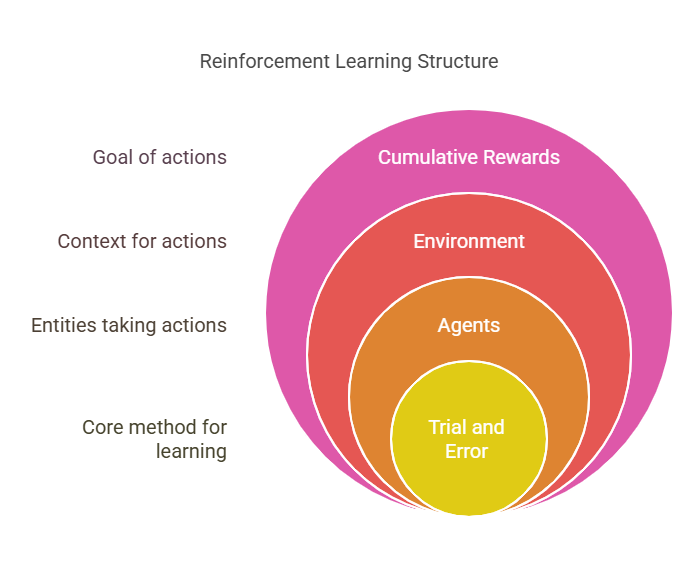
Reinforcement Learning (RL) is a specialized area of machine learning focused on how agents should take actions in an environment to maximize cumulative rewards. Unlike traditional learning paradigms, RL emphasizes learning through trial and error, allowing agents to adapt and optimize their behavior based on the outcomes of their actions.
Key Components of Reinforcement Learning
- Agent: The learner or decision-maker that interacts with the environment.
- Environment: The external system with which the agent interacts.
- State: A specific situation in which the agent finds itself within the environment.
- Action: All possible moves or decisions the agent can make.
- Reward: Feedback from the environment based on the action taken, guiding the agent’s learning process.

How Reinforcement Learning Works
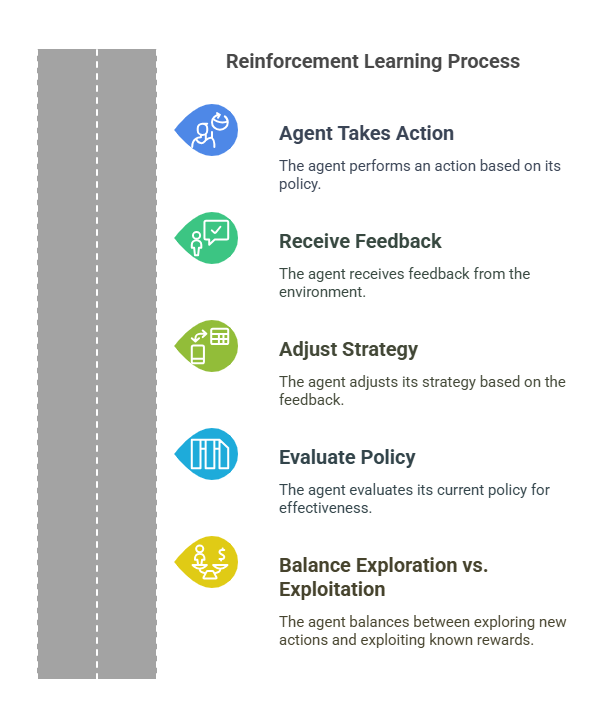
Reinforcement Learning operates on the principle of maximizing rewards through a feedback loop. The agent performs actions, receives rewards or penalties, and adjusts its strategy accordingly. This process is characterized by:
- Policy: A strategy that defines the agent’s actions based on its current state.
- Reward Function: A function that quantifies the feedback received from the environment.
- Value Function: An estimate of expected cumulative rewards from a given state, guiding future actions.
- Exploration vs. Exploitation: The challenge of balancing between trying new actions (exploration) and utilizing known rewarding actions (exploitation) to maximize overall rewards.
Differences Between Reinforcement Learning and Other Learning Types
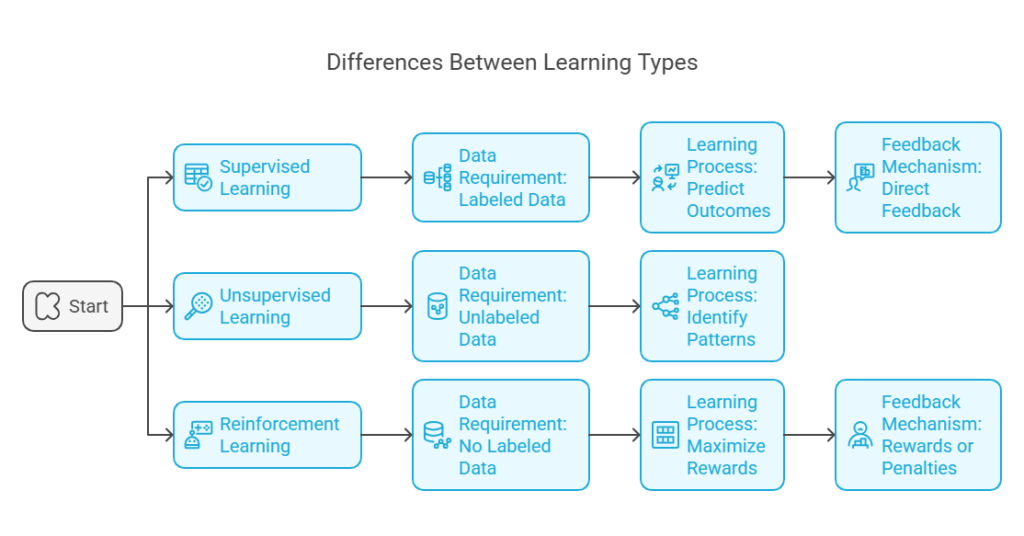
Reinforcement Learning is distinct from other machine learning paradigms such as supervised and unsupervised learning:
Applications of Reinforcement Learning
Reinforcement Learning has found applications across various fields, including:
- Robotics: Training robots to perform complex tasks in dynamic environments.
- Game Playing: Developing AI that can play games at superhuman levels (e.g., AlphaGo).
- Autonomous Vehicles: Enhancing decision-making processes for navigation and obstacle avoidance.
- Healthcare: Optimizing treatment plans through personalized patient interactions.

Conclusion
Reinforcement Learning represents a paradigm shift in how machines learn to make decisions autonomously. By leveraging trial-and-error methods and continuous feedback from their environments, RL agents can navigate complex problems without human intervention. This capability distinguishes RL from supervised and unsupervised learning, positioning it as a powerful tool for developing intelligent systems capable of adapting to new challenges.